
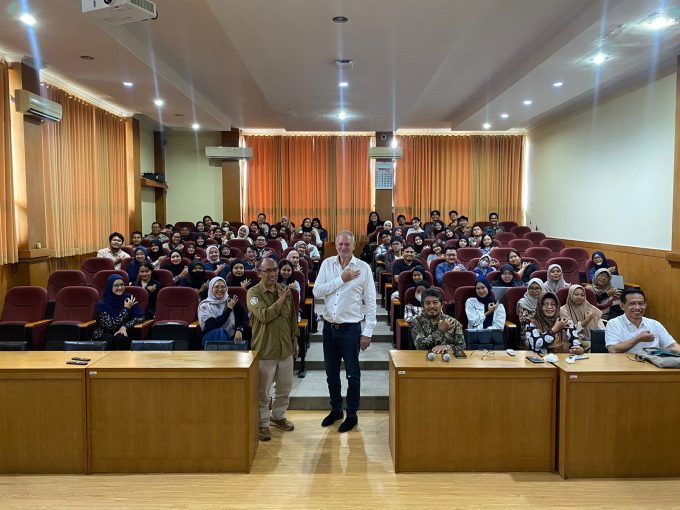
On Tuesday, 25 November 2025 at 09.00 a.m. WIB, the Department of Soil Science, Faculty of Agriculture, Universitas Gadjah Mada held a public lecture themed “From Knowledge to Business.” The event featured Brian Rhodes Thorrington, Honorary Consul of the Republic of Indonesia in Auckland, New Zealand, as the keynote speaker. The lecture took place at the MMA Auditorium, Faculty of Agriculture UGM, and was attended by Soil Science students from undergraduate (S1), master’s (S2), and doctoral (S3) programs.
The public lecture emphasized how knowledge and technology can be transformed into innovations that provide tangible benefits while also generating economic value. One example presented was the use of forage chicory as livestock feed enriched with selenium. Through this approach, selenium contained in the plant is absorbed by livestock and subsequently enters the human food chain through the consumption of meat or other animal products. Thus, this innovation not only improves the nutritional quality of animal feed but also has the potential to deliver health benefits to end consumers.
The discussion also highlighted the issue of stunting, which remains a serious challenge, particularly due to deficiencies in micronutrients such as selenium. One proposed solution is biofortification, namely increasing the nutritional content of food crops directly, for example in maize and rice. This strategy is considered more effective and sustainable because the enhanced nutrients are naturally available in staple foods that are consumed daily by large segments of the population.
The topics discussed were closely linked to several Sustainable Development Goals (SDGs). Efforts to improve nutritional quality through biofortification and livestock feed fortification support the achievement of SDG 2: Zero Hunger, particularly targets related to food security and nutrition. These initiatives also contribute to SDG 3: Good Health and Well-Being by helping to prevent stunting and micronutrient deficiencies in society.
Furthermore, the application of environmentally friendly technology and innovation in the food sector aligns with SDG 12: Responsible Consumption and Production. Beyond that, transforming knowledge into economically valuable innovative products opens opportunities for business development and job creation, supporting SDG 8: Decent Work and Economic Growth, as well as strengthening SDG 9: Industry, Innovation, and Infrastructure through the application of research in the food and livestock industries.
This public lecture is expected to broaden students’ perspectives on the importance of scientific research in driving innovation in the agricultural sector and in developing knowledge-based business models. Through this understanding, students are expected to contribute to building a more sustainable, inclusive, and adaptive food system in response to global challenges.
Author: Rina Damayanti
Editor: Firdausi Nur Azizah